How to Set Up a BOI Company in Sri Lanka
A clear overview of the Board of Investment (BOI), the legal framework, company types, key benefits, minimum investment requirements, zones, setup process, charges, and online services for setting up a BOI-approved project in Sri Lanka.
What is BOI Sri Lanka?
The Board of Investment of Sri Lanka (BOI) is the primary government agency responsible for approving Foreign Direct Investments (FDI) and local investments. It is governed by the Board of Investment Law No. 4 of 1978 (BOI Law) and its subsequent amendments.
Established in 1978 as the Greater Colombo Economic Commission, the BOI currently oversees more than 1,700 projects. It provides investors with a wide range of services including Import/Export Facilitation, Industrial Labour Relations, Legal Services, Engineering Approvals, and Environmental Clearances.
In short, the BOI is the central gateway that foreign (and many local) investors must go through to obtain formal approval to commence business operations in Sri Lanka.
What is the BOI Act Sri Lanka?
The core legislation is the Board of Investment Law No. 4 of 1978. Six amendments have been enacted over the years, forming the full legal framework under which the BOI operates:
In addition to the BOI Law, investors must comply with several other key statutes:
1. Finance Act No. 12 of 2012 (Hub Operations)
Designed to promote Sri Lanka as a trading hub. It covers trading and services activities, Free Ports and Bonded areas, and enables transactions in convertible foreign currencies.
2. Inland Revenue Act No. 24 of 2017
The principal tax legislation applicable to both foreign and local investors. It sets corporate income tax rates and provides exemptions/zero rates for sectors such as SMEs, exports of goods, education, tourism, construction, healthcare, agro-processing, agro-farming, IT and export of services.
3. Strategic Development Projects Act No. 14 of 2008
Covers projects of national interest that meet criteria such as:
- Strategic importance of goods/services that benefit the public
- Substantial inflow of foreign exchange
- Significant employment generation and income opportunities
- Technology transformation — eligible for case-by-case tax relief
4. Foreign Exchange Act No. 12 of 2017
Replaced the old Exchange Control Act and introduced a more liberal regime. Investors can work directly with preferred banks and use Inward Investment Accounts (IWA) and Outward Investment Accounts.
Key Exclusions
- • Pawnbroking
- • Retail trade (capital < USD 5 Mn)
- • Coastal fishing
Limitations (up to 40% foreign ownership unless special BOI approval)
- • Certain primary agriculture & processing
- • Mining of non-renewable resources
- • Mass communication, education, freight & shipping agencies
- • Deep-sea fishing, timber-based industries, etc.
5. Land Policy (Land Acts)
Governed by the Land (Restrictions on Alienation) Act 2014 and its 2017 & 2018 amendments. Foreign investors may lease land for up to 99 years (no lease tax). Outright ownership is possible when foreign shareholding is below 50%. Condominium properties can be purchased outright with no nationality restrictions.
What is a BOI Company or BOI Approved Project?
Terms such as “BOI company”, “BOI registered company”, “BOI approved company” or “BOI approved project” all refer to the same thing: a company that has successfully completed the BOI approval process and is authorised to operate under the Board of Investment framework in Sri Lanka. Once approved, the enterprise is entitled to the relevant incentives and facilitation services offered by the BOI.
Benefits of Registering with the BOI
BOI registration is designed to attract FDI. Approved companies receive both fiscal and non-fiscal incentives.
Fiscal Incentives
- Enhanced capital allowance of 100%–150% (plus normal depreciation) for depreciable assets over USD 3 Mn
- Enhanced capital allowance of 200% for projects in the Northern Province
- Reduced Corporate Income Tax rates of 14%–18% for specific sectors
- Zero Corporate Income Tax for Agro Farming, IT & enabling services, and export of services
- Dividend tax exemptions
- Port & Airport Levy exemptions
- CESS exemptions on capital goods, raw materials and tourism projects
- VAT exemptions and deferments
- Customs Duty exemptions
Non-Fiscal Incentives
- 100% foreign equity ownership and full repatriation of earnings
- Access to dedicated BOI Zones
- Investor services: engineering approvals, import/export documentation facilitation, and land provisions
- Facilitation of expatriate entry visas, residence visas, temporary visas and extensions
What is the BOI Sri Lanka Minimum Investment?
The minimum investment required depends on the section of the BOI Law under which the project is approved:
Section 17 Projects
USD 3 Million+
Projects meeting the USD 3 Mn threshold (and sector-specific criteria) can enjoy special incentives.
- Corporate tax concessions
- Customs duty-free import of capital goods & raw materials
- Exemptions from certain exchange control provisions
- Possible qualification as a Strategic Development Project (tax exemptions up to 25 years)
Section 16 Projects
USD 250,000
Minimum investment of USD 250,000 (100% foreign or joint venture). Trading activities require a minimum of USD 5 Million.
- Facilitates entry of foreign investment
- Allows setting up a new company with foreign shareholding
- Enables transfer or issue of shares in an existing non-BOI company to foreign investors
- Subject to normal country laws, Customs and Exchange Control regulations (no special fiscal concessions)
BOI Zones in Sri Lanka
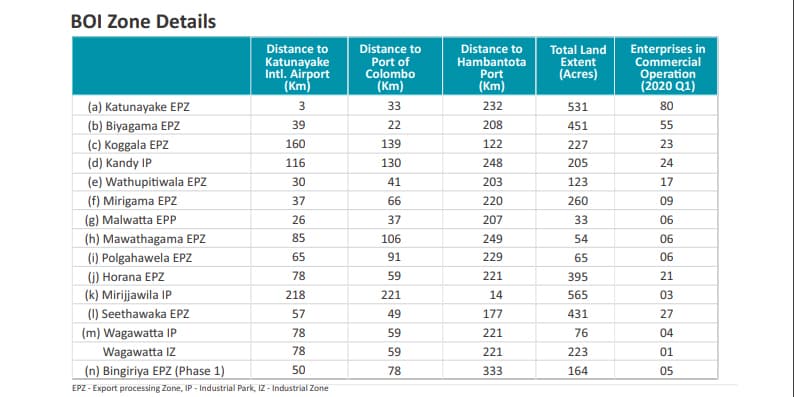
There are currently 14 BOI Export Processing Zones (EPZs) and Industrial Parks across Sri Lanka, with plans for additional zones in the future. These zones provide ready infrastructure, security, and streamlined facilitation for export-oriented and manufacturing projects.
How to Set Up a BOI Registered Company
While the BOI facilitates foreign direct investment, the process involves multiple steps. For clarity, it is broken down into three main phases.
Phase 1 — Application & Initial Approval
Submit either a Section 16 or Section 17 application (depending on the concessions you seek). You must be a shareholder or an authorised representative.
Section 17 Fees
Investment < USD 25 Mn → USD 150 + 12% VAT
Investment ≥ USD 25 Mn → 0.01% of proposed investment + 12% VAT
Section 16 Fees
USD 175 + 12% VAT
Section 16 applications must include:
- Draft Articles of Association of the Company
- Statement of proposed shareholders and shareholdings (signed)
- Statement of names & addresses of proposed Directors (signed)
- Proof of inward remittance and bank credentials of investors
- Letter of authority (if submitted by a representative) showing each foreign collaborator’s equity contribution
After assessment by the Project Screening Committee you receive a Letter of Acknowledgment of Business Activity and are assigned a project officer.
Phase 2 — Incorporation & Formal Approval
Register the company in Sri Lanka, then obtain the required clearances.
- Company registration (Private Limited Company)
- Project Activity clearances (Preliminary, Environment, Site, Raw-material sourcing, Rules of Origin, Import/Export Licence)
- Site approval via BOI Engineering Approvals Department + Environmental Clearance
- Formal Approval Letter from BOI
- Preliminary Planning Clearance for the building and collection of the draft BOI Agreement
Phase 3 — Agreement Signing & Commencement of Operations
Sign the BOI Agreement (which sets the implementation period), then complete the post-agreement formalities:
- Open an Inward Investment Account with a Foreign Currency Banking Unit
- VAT / TIN registration (Inland Revenue Department)
- Development Permit (Building Approvals)
- Utilities – Electricity, Water, Telecommunication
- Certificate of Conformity (COC)
- Import/Export Registration (Sri Lanka Customs)
- Recommendation for Work Permits & Residence Visas (BOI)
- Obtain Work Permit & Residence Visa (Ministry of Defence / Immigration)
- Duty-free Import / Export approvals (BOI)
- Environment Protection Licence (EPL)
Once all approvals are in place, commercial operations can commence.
What are the Charges by BOI Sri Lanka?
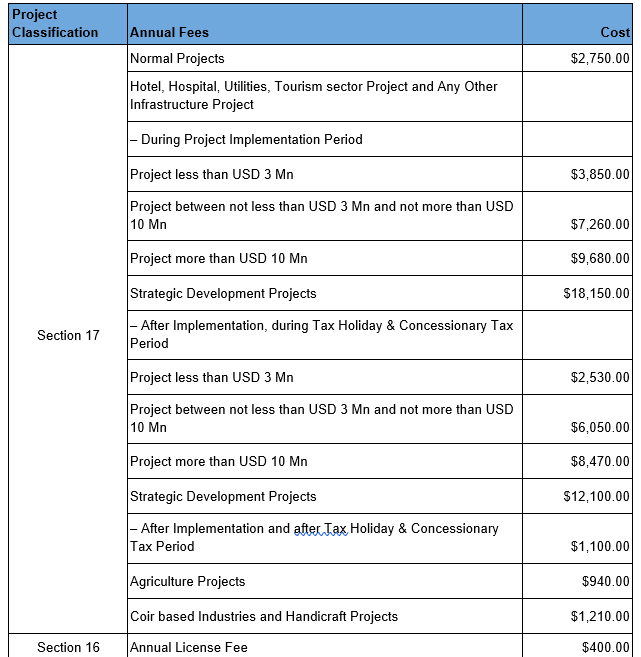
There are three main categories of charges payable to the BOI (plus applicable VAT). Amounts can be paid in the Sri Lankan Rupee equivalent at the prevailing exchange rate.

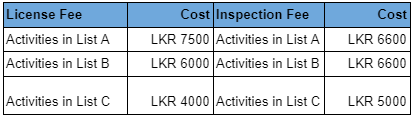
3. Environment Protection Licensing Charges
Services Accessible through the BOI Website
The official BOI portal investsrilanka.com offers a range of online services for both potential and existing investors:
Job Bank
Browse and post employment opportunities linked to BOI projects
Apply Visa Online
Submit and track expatriate visa applications
Web Submission
Online submission of applications and documents
Declarant Portal
Customs and trade-related declarations
Land Bank
View available land within BOI zones
Online Local Sales System
Manage local sales transactions for BOI enterprises
Import/Export Management Portal
Handle import and export documentation online
ID Issuing System
Request and manage investor / employee identification
Ready to start your BOI journey?
CIMA guides you through proposal preparation, approvals, construction support and ongoing compliance — one partner from concept to operations.
